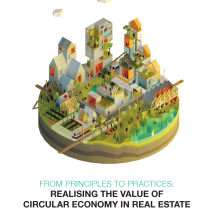
Arup has joined forces with the Ellen MacArthur Foundation to produce a report on the value of circular economyin real estate.
The circular economy offers real estate investors a framework for achieving environmental and social goals while delivering better economic performance. How do real estate business models need to change - apart from eco-design - if circular principles are to scale up in this sector?
The report defines five models to improve financial performance to the benefit of real estate investors and construction clients:
In 2018, the National Institute for Circular Economy (INEC) launched an Operational Programme on Purchasing and Circular Economy, together with the Métropole du Grand Paris and the Observatoire des Achats Responsables. Drawing on participants' experiences, these guidelines aim to guide private and public buyers through integrating the circular economy into their purchasing policies.
Ethical smartphones, multifunctional strollers, remanufactured milking robots and bicycles-as-a-service: the Dutch manufacturing industry offers plenty of inspiring and groundbreaking innovations for a circular economy. International cooperation is nonetheless crucial to deliver and accelerate the circular transition as the value chains of the manufacturing industry cover the whole world.
With this publication, Holland Circular Hotspot and the Dutch Circular Manufacturing Implementation Programme (UPCM) aim to bring insights and case studies from the Netherlands to an international level, in order to inspire everyone around the world to act and kickstart circular development.
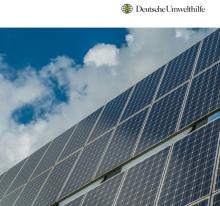
Every year, huge numbers of photovoltaic modules are being installed. This solar energy expansion greatly furthers the ecological transformation of the energy system. But to solve the climate crisis every aspect has to be taken into consideration. This is why this white paper wants to shine light on challenges currently occurring or to be expected in connection with used photovoltaic modules and their disposal in Germany.
To better implement the goals of a circular economy, this paper will retrace the steps in the lifecycle of a photovoltaic module and analyse problems and possible solutions along these stages. After a brief description of the challenges, it presents effective and sensible opportunities and solutions.
Renewable energy technologies, such as wind turbines, solar photovoltaic panels and batteries, are essential for Europe’s transition to climate neutrality. Deployment, maintenance and replacement of this infrastructure requires significant resources, including many substances included in the EU list of critical raw materials.
Waste arising from end-of-life clean energy infrastructure is projected to grow up to 30-fold over the next 10 years, presenting significant opportunities to reduce consumption of scarce raw materials by recycling metals and other valuable resources back into production systems.
Circular economy approaches such as repair and upgrading of equipment and recycling of end-of-life infrastructure can underpin the sustainability credentials of EU renewable energy.
The Commission has opened a public consultation on the review of the Directive on the end-of-life vehicles (ELV). It is targeted especially at two stakeholder groups: 1) citizens with a general interest in the area of end-of-life vehicles; 2) stakeholders (economic operators, NGOs, public administrations…) who have specific knowledge and/or interest about end-of-life vehicles. Let's participate!
Welcome to the circular economy event of the year, World Circular Economy Forum 2021, on 13-15 September 2021!
Hosted for the first time in North America, WCEF 2021 will focus on the system level changes, or “game changers,” needed to accelerate the transition to a circular economy.